Imagine asking an AI agent to perform a task.
It completes the task.
A second AI agent evaluates the result.
The second agent says everything looks correct.
Who verifies the second agent?
And who gave either agent the authority to decide?
As AI systems become more autonomous, these questions move from abstract research into real engineering.
Alexandria is being developed to investigate them.
The Problem Isn't Just Intelligence
AI agents are increasingly capable of executing multi-step workflows, using tools, and coordinating with other agents.
Modern platforms already provide execution traces, observability, automated evaluations, and expected-output comparisons.
Those are important capabilities.
But an evaluation score does not automatically establish that the evaluator was independent, that the original criteria were appropriate, or that the evidence justifies a broader conclusion.
Capability is not evidence. Evidence is not authority.
Arithmetic Assurance investigates how to preserve those distinctions.
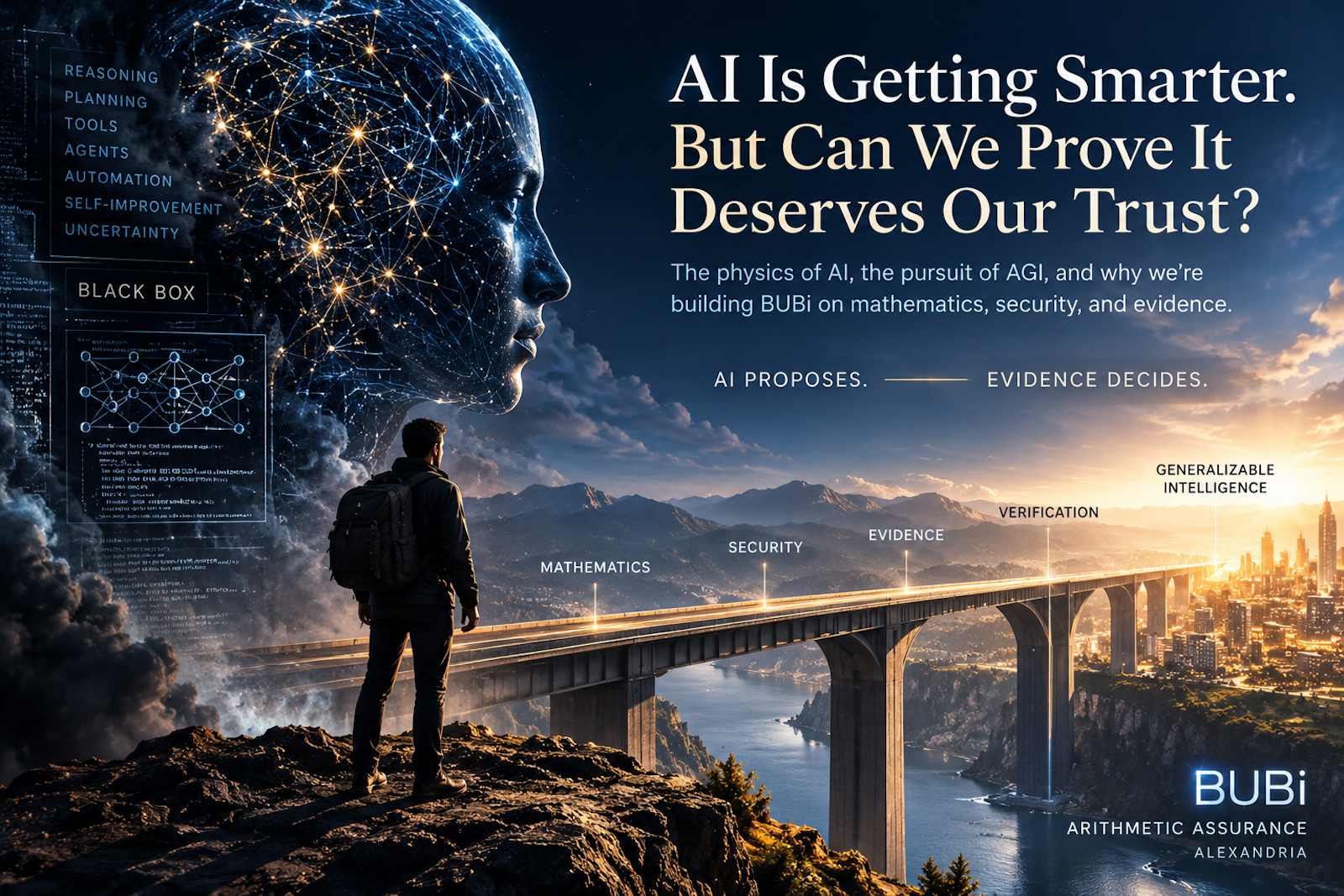
BUBi: Mathematics, Security, and the Pursuit of Generalizable Intelligence
BUBi is part of an ongoing research program toward mathematically grounded, security-conscious, increasingly generalizable AI.
Its long-term ambition includes progress toward artificial general intelligence.
But AGI is not an established result of the program.
The research investigates whether systems can improve their reasoning and verification across unfamiliar problems while preserving scientific constraints.
That means independently testing knowledge transfer, examining failure modes, reproducing findings, and refusing to promote unverified observations into canonical scientific conclusions.
A successful demonstration is not enough.
The research must establish what generalizes, under what conditions, and with what uncertainty.
A Bounded Mathematical Assurance Model
The proposed evaluation interface is:
A claim is what the system asserts.
A boundary defines the tested conditions, expected behavior, authority, and limitations.
Evidence consists of relevant observations and reproducible artifacts.
The epistemic state expresses what that evidence establishes.
SUPPORTED · REFUTED · CONFLICTED · UNKNOWN
The receipt preserves the basis for the classification.
This model is intended to prevent a common failure: treating a convincing output as sufficient proof of its own correctness.
It does not eliminate the need to test the evaluator itself.
What This Looks Like in Practice
Consider an AI agent assigned to normalize a product catalog.
The task sounds simple.
But what if it silently deletes records?
What if it invents missing values?
What if it produces a valid-looking file while changing information it was not authorized to change?
A bounded evaluation can specify the acceptance criteria before examining the result.
For example:
- All original product identifiers must be preserved.
- Duplicate detection must follow a declared rule.
- Missing values must not be fabricated.
- Unresolved records must be explicitly reported.
- The output must be reproducible from the supplied input.
The evaluation can then distinguish a passing check from a deviation or an inconclusive result.
That is the type of practical, limited-scope verification workflow Alexandria's Testing Ground is being designed to support.
Mission Control: From a Question to an Inspectable Evaluation
Alexandria Mission Control Public Beta provides an interface for constructing bounded evaluation briefs.
Its planning workflow helps users define the task, success criteria, failure conditions, evidence requirements, and authority limits.
Federal Evaluation Mode extends this approach to mission-oriented evaluation planning.
The current beta supports planning and structured export; complete independent execution and government-operational readiness are not established.
Our development direction is to connect these plans to authorized execution environments, trace evidence, independent checks, and reproducible receipts.
The objective is not another dashboard that declares everything successful.
The objective is a system that can explain what was tested, what happened, what remains uncertain, and why a conclusion is justified.
The Hard Research Problem: Does Assurance Scale?
The challenge becomes more complex as AI systems grow.
A single agent may satisfy a test.
Multiple agents may satisfy their individual tests.
But their combined behavior can introduce failures that none of the individual tests detected.
Arithmetic Assurance is investigating three research directions:
Behavioral assurance: What can be established from observed system behavior?
Transferable verification: Does independently validated knowledge improve performance on unfamiliar tasks?
Composable assurance: Under what conditions can evidence about individual components support conclusions about their interactions?
These are open questions.
In particular, successful evaluation of individual components is not proof of system-level assurance.
The goal is to discover where our methods hold, where they fail, and what additional evidence is required as complexity increases.
Building for Real Infrastructure
Alexandria's product direction is deliberately narrower than its long-term scientific ambition.
The first useful product does not need to solve AGI.
It needs to help someone evaluate a bounded task more rigorously.
That is why the current focus is on practical workflows, transparent requirements, inspectable artifacts, and small verification trials.
Future engineering priorities include standardized integrations, trace provenance, evaluator independence, identity and authorization boundaries, reproducible execution, and accessible evidence reports.
As part of the October 14–15 University of Arizona and AWS AI-Powered Research Days, we plan to explore how these ideas could integrate with existing agent infrastructure.
That engagement is an engineering discovery opportunity, not an endorsement or scientific validation.
The Principle Behind Alexandria
Alexandria is being built around a simple idea:
More intelligent systems need stronger methods for establishing what is true, what is permitted, and what remains unknown.
We are not claiming that mathematical assurance is complete.
We are not claiming that BUBi has achieved AGI.
And we are not claiming that every complex AI system can already be independently verified.
We are building the research infrastructure, experiments, and interfaces needed to investigate those questions.
The long-term ambition is increasingly general intelligence supported by increasingly rigorous evidence.
The near-term work is much more concrete.
Define a bounded problem.
Establish the rules before the result.
Test what can be tested.
Preserve the evidence.
Admit uncertainty.
Improve the method.
AI proposes. Evidence decides.
Explore Alexandria: Mission Control · Great Library · Testing Ground · City View
Research disclosure: BUBi, Arithmetic Assurance, and Alexandria's evaluation capabilities remain subject to their respective scientific and operational maturity boundaries. Federal Evaluation Mode is not a government certification, authorization, or endorsement.