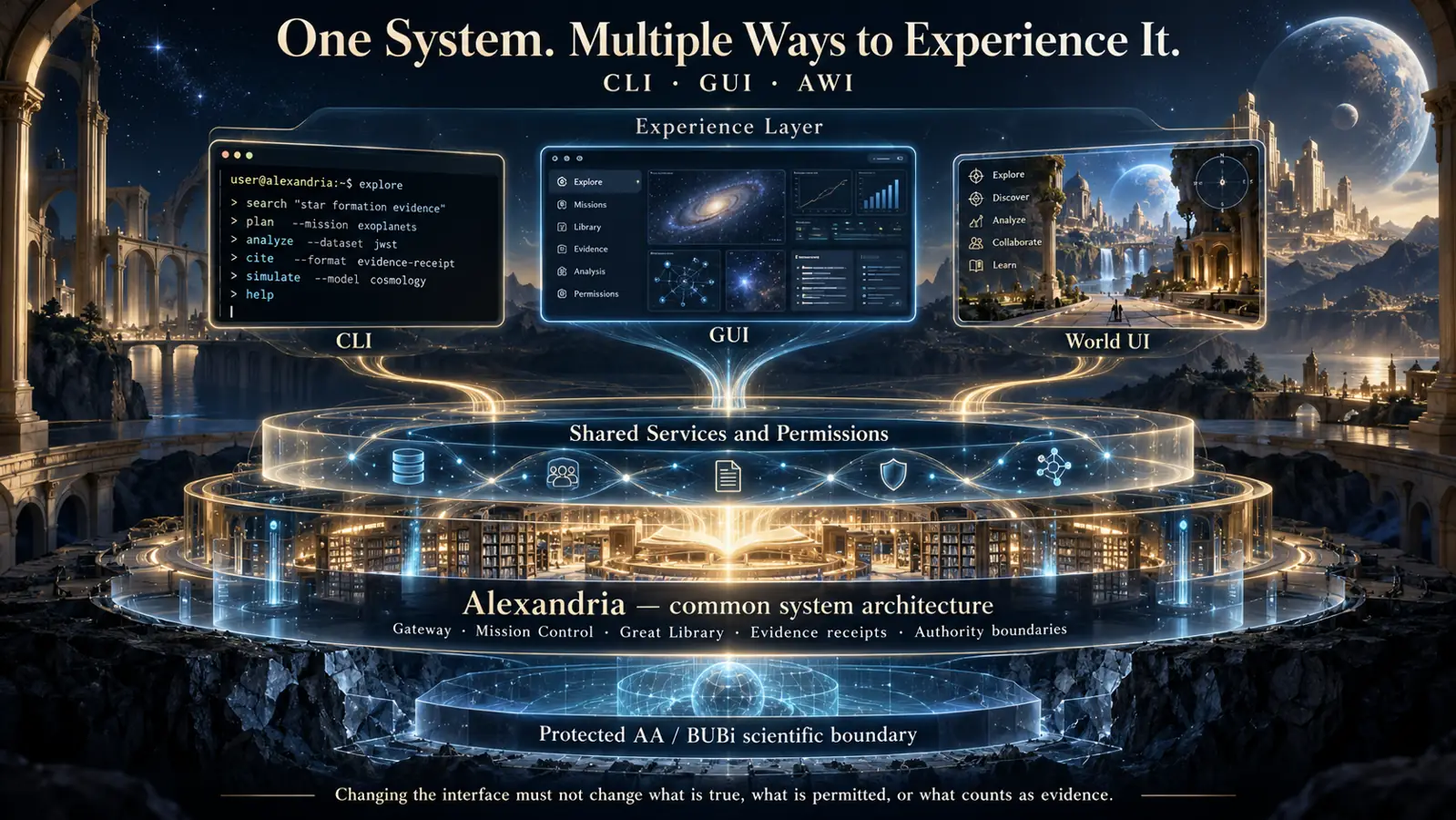
What if the next generation of intelligent software was not confined to another chat window? A developer could use commands. A researcher could use a dashboard. A future visitor could walk through a digital city, enter the Great Library, and discover the same authorized research service. Each experience would feel different—but the underlying record of what is permitted, observed and supported would remain the same.
That is the purpose of Alexandria Multiview Architecture, our working architectural concept, and AWI — Agentic World Interface, the planned spatial and gamified view of Alexandria.
This is a design and research direction, not a claim to have invented a new computing standard or finished a complete world platform.
The scientific rule underneath the interface
The interface is a presentation layer, not a grant of authority. Its job is to let people reach useful services without changing the constraints those services must obey.
The interface can change. The authority cannot. The evidence cannot. And the truth does not change just because we entered a different world.
In practical terms, an operation denied in a web interface must not become authorized inside a game. Research metadata retrieved from a source does not become independently verified merely because it appears in a beautiful library. A visitor earning a simulated quest badge must not alter scientific, account, parcel or payment records.
These are architectural invariants we intend to test, not performance achievements we are entitled to assume.
Three experiences of one governed system
CLI — the command-line view. Developers and properly authorized agents could interact through structured commands and service interfaces. A command's apparent power would never exceed its granted permissions.
GUI — the graphical view. Researchers and operators can use familiar pages and dashboards. Alexandria already has web interfaces for the Great Library and Mission Control.
AWI — the world interface. The longer-term plan is to make the city an explorable navigation environment with institutions corresponding to real, governed functions: the Great Library for source discovery; Mission Control for bounded evaluation design; the Testing Ground for scoped testing; and, eventually, Buba-connected business and operational services.
The proposed unifying principle is a canonical service and permission model beneath all three views, with spatial representation as a client rather than an independent source of truth. The current synthetic Unity scene is not yet a production connection to that future shared backend.
A visible development milestone
On October 9, 2026, the team reached an initial, verifiable milestone in an isolated Unity 6.6 Apple Silicon project. The C# scripts compiled; the editor generated a three-building synthetic plaza scene; and automated structural scene acceptance passed. The prototype represents the Great Library, Mission Control and Testing Ground. Source, generated scene, logs and SHA-256 receipts were preserved.
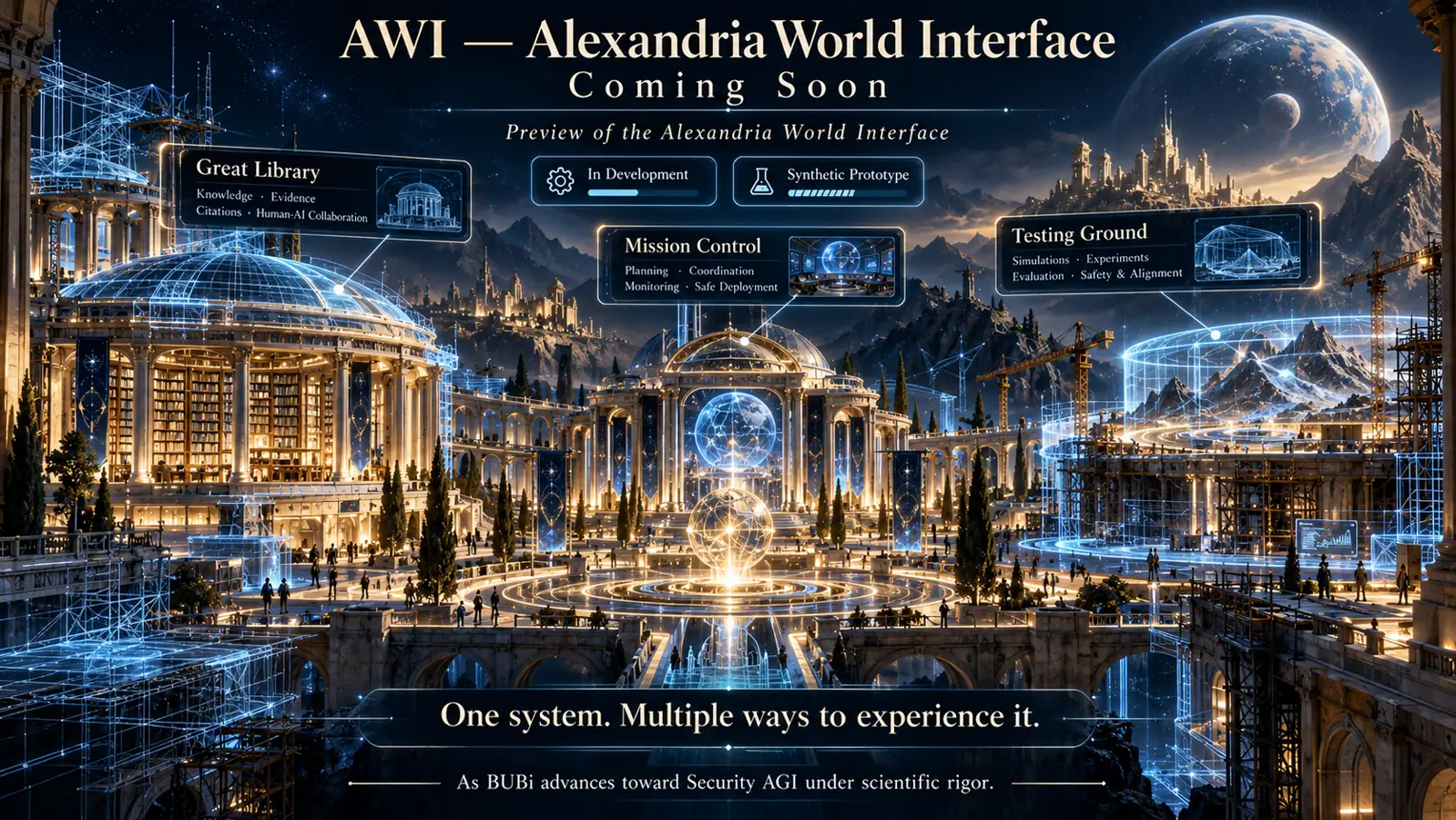
- Unity C# compilation and synthetic scene creation: passed scoped checks.
- Automated structural scene acceptance: passed.
- Manual visual/keyboard interaction, browser WebGL, performance and accessibility measurements: not yet established.
- Production world deployment and BUBi integration: not authorized.
A scene that compiles is not necessarily usable. A prototype that looks compelling is not necessarily accessible. Before promoting an experience we must observe genuine interaction, test the failure cases, measure performance, preserve a text/2D alternative and verify that the world cannot cross authorization boundaries.
The Great Library, Mission Control, Buba and the protected scientific core
Alexandria's public Great Library is a source-discovery environment. It keeps provenance visible, but citations do not automatically establish the claims inside them. Mission Control provides a bounded browser-based evaluation brief builder, an explicit UNKNOWN demonstration and JSON brief export; a brief is not an independent scientific trial.
Buba is our emerging commercial and operational workstream for bounded verification, catalog completeness and evidence receipts. Its $49 Catalog Readiness offer is offered, not established as contracted or paid revenue.
Arithmetic Assurance / BUBi is different again. Its protected scientific program investigates whether claims about increasingly capable AI can be evaluated using evidence independent of the system making the claim. Product interfaces, commercial incentives, player actions and graphic effects have no authority to change BUBi's scientific state.
BUBi's proposed A4 transfer advantage on unfamiliar holdouts remains NOT ESTABLISHED. A longer-term aspiration toward security-oriented generalizable AI—sometimes called Security AGI—is a research goal, not an achieved capability. Alexandria is designed around that distinction.
How the world earns the right to grow
The next milestones are concrete: human visual and keyboard playtests; a genuine browser/WebGL build; independent checks of synthetic service and authority boundaries; readable text/2D alternatives; measured loading and resource use; and a reversible, explicitly approved release process.
Open delivery standards such as Khronos glTF offer future 3D interoperability paths. The WCAG 2.2 recommendations are an important accessibility reference. Neither standard substitutes for implementation or human testing.
Eventually, the city may provide memorable spaces for source discovery, verification education and trustworthy human–agent interaction. But the purpose is utility, not a virtual landscape for its own sake.
One system. Multiple ways to experience it. One boundary that the interface cannot override.
AI proposes. Evidence decides.
Explore the Alexandria already online
Mission ControlGreat LibraryCity ViewTesting GroundNotes on provenance: This article separates public web functions from product roadmap hypotheses and verified synthetic Unity scene checks. Concept imagery is original illustrative artwork. No protected scientific holdouts, keys, evaluator custody or independent adjudication were accessed to prepare this publication.