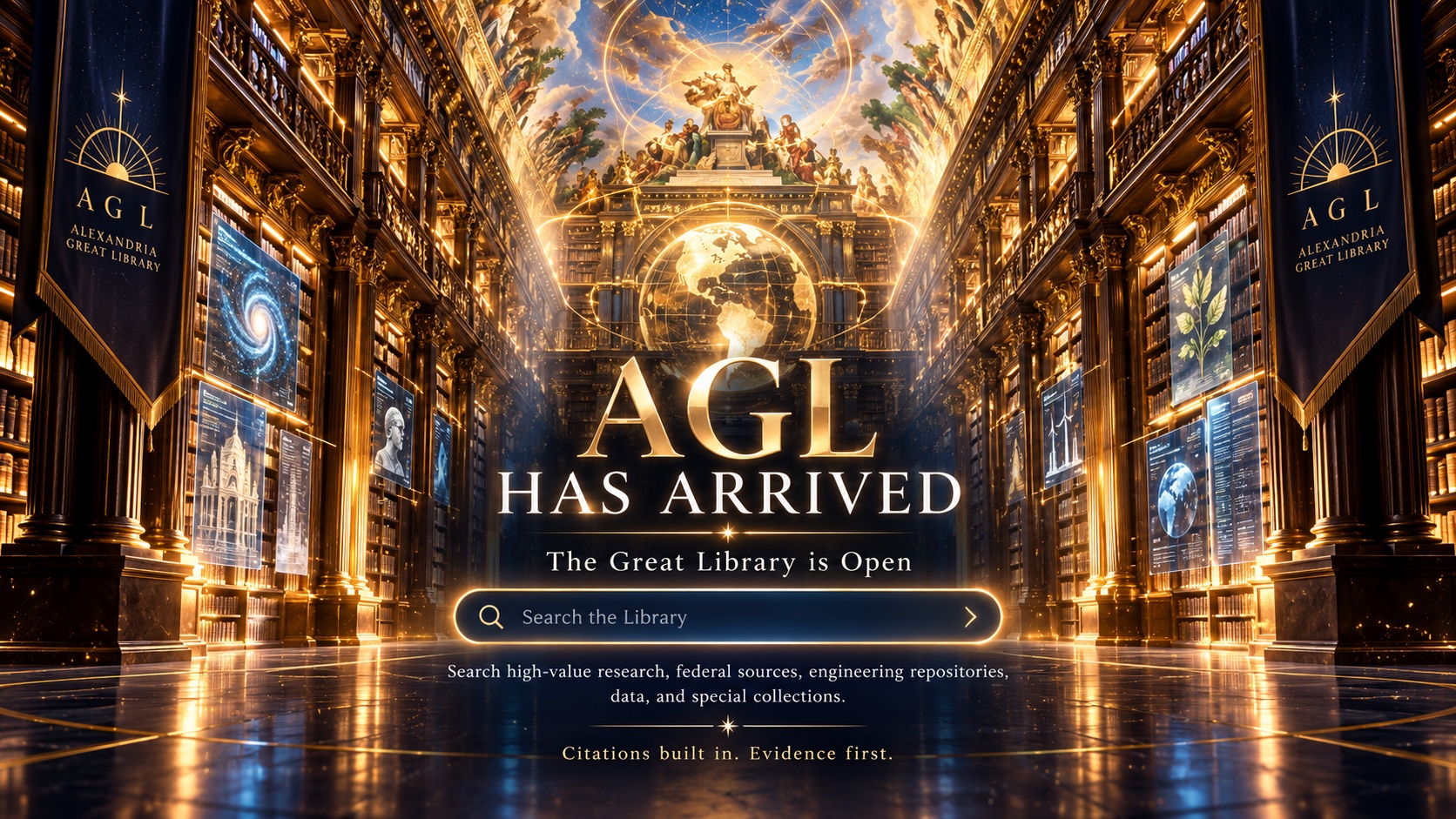
For thousands of years, humanity has built libraries to preserve what we know.
Now we need one built for humans and machines.
Alexandria’s Great Library — AGL — is now open. AGL is a research infrastructure designed to connect high-value knowledge repositories into a single provenance-first discovery system while keeping the source, evidence boundary, and uncertainty visible.
This is not another general web search engine. It is not a chatbot pretending that every answer is knowledge. And it is not a black box that asks you to trust a confident sentence.
AGL is being built as a repository layer for deep human knowledge — with provenance and uncertainty kept visible.
What the Library spans today
- Scientific and academic research — scholarly papers, DOI records, research graphs, medical literature, citation counts, authors, retraction signals, and research metadata through live connectors including Crossref, OpenAlex, PubMed, DataCite, and Zenodo.
- United States federal research — live discovery across NASA NTRS, DOE OSTI, and NIH/NLM PubMed, with additional federal discovery paths maintained separately.
- Data and research artifacts — datasets, software, reports, experiments, technical outputs, and versioned research objects.
- Engineering and software knowledge — an expanding architecture for public code, repositories, technical artifacts, software evidence, and reproducibility. This engineering layer is still being expanded and should not be confused with a claim that every engineering repository is already live-searchable.
- Human knowledge and cultural preservation — special collections that preserve important material outside traditional academic publishing.
- The Uncensored Library — the Minecraft-based project created to preserve journalism censored in parts of the world. Alexandria preserves provenance and routes visitors to the official project and source materials rather than pretending to own the work.
- Agent-readable knowledge — structured resources designed so AI systems can discover evidence without silently converting discovery into scientific truth.
And this is only the beginning.
Citations are now built into AGL
A Great Library result can now generate citation metadata in APA · MLA · BibTeX · RIS.
But we are taking an important position:
A citation is not proof.
AGL can help you find the source. It can preserve where the information came from. It can expose identifiers, citation counts, access information, and warning signals.
But a citation by itself does not establish that a claim is true.
That distinction matters enormously in the age of generative AI.
Search → Evidence → Verification
The next generation of research infrastructure should not stop at:
“Here are ten links.”
Search → Evidence → Verify → Receipt
The direction of AGL is to let a researcher ask a scientific question and eventually see not merely what has been published, but how the evidence relates to the claim.
The goal is not to eliminate uncertainty.
The goal is to make uncertainty visible.
A Library that learns
Traditional libraries preserve knowledge. AGL is designed to preserve knowledge and learn how that knowledge is being discovered, connected, verified, rejected, and revisited.
The product layer can learn which repositories answer which kinds of questions well, where evidence coverage is weak, how query routing should improve, what research paths are repeatedly useful, and which workflows help humans and agents reach better-supported conclusions.
But there is a hard boundary:
AGL may learn how to help you search better. It does not get to decide what is true because users clicked it more often.
Candidate improvements should be measured and tested. Popularity is not evidence. Product learning cannot directly rewrite Arithmetic Assurance or BUBi scientific truth.
Learning improves the map. Evidence still decides the territory.
Built for the edge of science
AGL is being designed for work where ordinary search is not enough: AI and computer science, physics, medicine, biology, engineering, cybersecurity, space, energy, mathematics, government research, datasets, software, cultural archives — and fields that do not exist yet.
The ambition is to give humans and intelligent machines a common research layer where high-value evidence can be discovered without silently losing its provenance.
Not “AI search.” Research infrastructure.
General AI systems such as ChatGPT, Gemini, Claude, and others are becoming extraordinary interfaces to information.
AGL is pursuing a different layer of the stack.
They can help reason over information. AGL is being built to help establish where the information came from, what kind of evidence it is, what can actually be concluded from it, and what remains unknown.
That distinction becomes increasingly important as AI begins conducting research, writing software, operating tools, and making decisions on behalf of humans.
Free during the founding period
For now, the Great Library remains free to use during its founding period while we expand the repository network, learn how humans and agents use it, improve evidence classification, and develop the next layers of the system.
We would rather build something people genuinely depend on before deciding where premium boundaries belong.
Basic discovery should remain extraordinarily useful.
Future paid layers may eventually include advanced evidence synthesis, large research projects, automated monitoring, engineering verification, team workflows, private data, APIs, evidence receipts, and enterprise or federal evaluation infrastructure.
But first:
Build the Library.
The deeper architecture
AGL is part of Alexandria.
Alexandria is being built as an environment where humans and AI agents can search knowledge, test claims, inspect evidence, run bounded evaluations, and preserve what was actually established.
At the core is the Oracle layer, powered by Arithmetic Assurance (AA). Its purpose is not to simply generate another answer. It is to preserve the distinction between:
claim · evidence · authority · uncertainty
Underneath that is our mathematical assurance research stack — including BUBi — investigating whether increasingly capable AI systems can reason, verify, transfer knowledge, and improve while remaining constrained by evidence.
We are not claiming that problem is solved.
We are building the infrastructure to investigate it.
And that may be the most important difference.
AGL HAS ARRIVED.
The Great Library is open.
Search deeply.
Preserve provenance.
Cite the source.
Test the claim.
Admit uncertainty.
AI proposes. Evidence decides.
Current Great Library search is a public beta. Search results are SOURCE_ONLY until separately verified. Citation metadata can contain upstream-source errors and should be checked before formal submission. AGL does not claim that every indexed or linked source is scientifically validated.