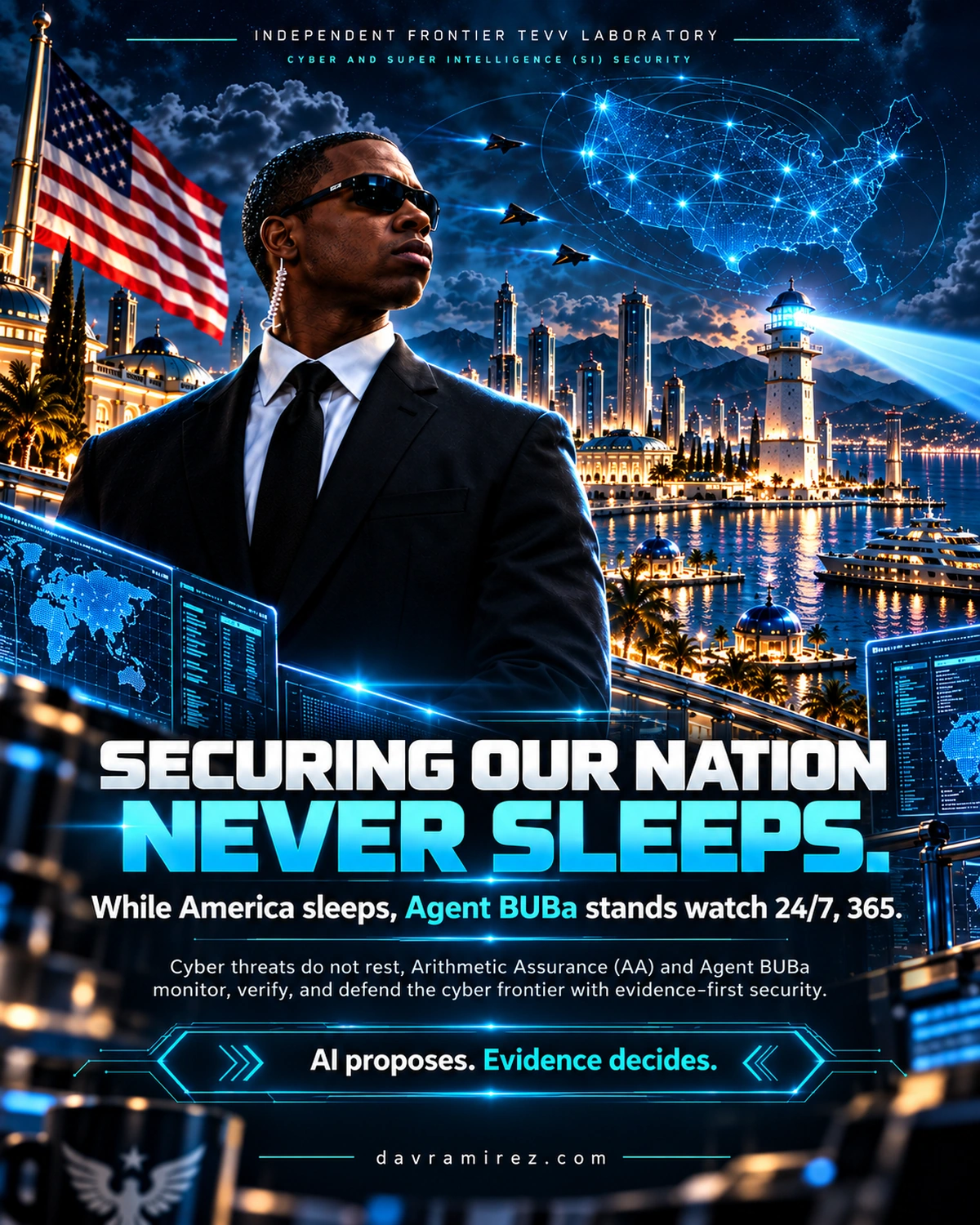
A city can sleep. An unverified security assumption cannot.
At the boundary between human decisions and autonomous agents, the dangerous moment is rarely cinematic. It's a quiet permission granted without scrutiny. A tool output accepted as fact. A workflow that moves from observation to action without a human ever seeing the evidence.
That is the world the Agentic World Interface (AWI) is being built to study.
Why the lighthouse matters
In Alexandria, our research city, the lighthouse is both architecture and an engineering metaphor. It can signal what is visible, what is unknown and where evidence should be sought. It cannot by itself certify that an entire network is safe.
Our public Lighthouse feed and research directory are discovery surfaces. They help people and systems find publications and research artifacts. They are not a hidden, privileged national-security command center.
The night-watch agent is not above the law of evidence
Agent BUBa represents the bounded service and execution side of the research program: receive a legitimate request, operate within a stated scope, keep receipts and submit consequential actions to authority checks. Mission Control owns routing and authorization. Arithmetic Assurance / BUBi is the protected scientific core. They are not interchangeable roles.
If a test fails, the system must be able to report REFUTED. If results disagree, CONFLICTED. If a question has not been answered, UNKNOWN. No superhero imagery changes a scientific result.
We can pursue security intelligence without surrendering the idea of independent truth.
Threats do not sleep. Evidence must be able to keep pace.
Consider an autonomous workflow that sees an alert at 2 a.m. and proposes a response. Before an agent isolates a service or changes a permission, the system should ask: What triggered the alert? Can the source be verified? Which action is authorized? Is the action reversible? Who reviews the result? What remains uncertain?
Those questions are more protective than a slogan promising that an AI will defend the nation while everyone sleeps.
Twenty-four-hour readiness is an aspiration to be demonstrated through uptime, monitoring coverage, alert quality, resilience and independent evaluation. We are not claiming that BUBa has already passed those tests as a continuously operating national cyber-defense service.
The secure, agent-native internet is still a research frontier
AWI investigates an agent-native layer where identity, capability, consent, bounded authority and evidence can travel with interactions. Alexandria is the playable prototype city. The long-term vision is a more secure alternative architecture to parts of today's internet—not a currently deployed replacement for HTTPS.
Our obligation is to make that ambition testable. Secure discovery is useful. A protected science core is essential. A gateway that never mistakes a request for permission is non-negotiable.
“AI proposes. Evidence decides.”
America does not need a machine that looks like a guardian. It needs systems that can show their work, including when the answer is no.
Read David Ramirez's founder essay · Follow the public Lighthouse research feed · Explore public research discovery
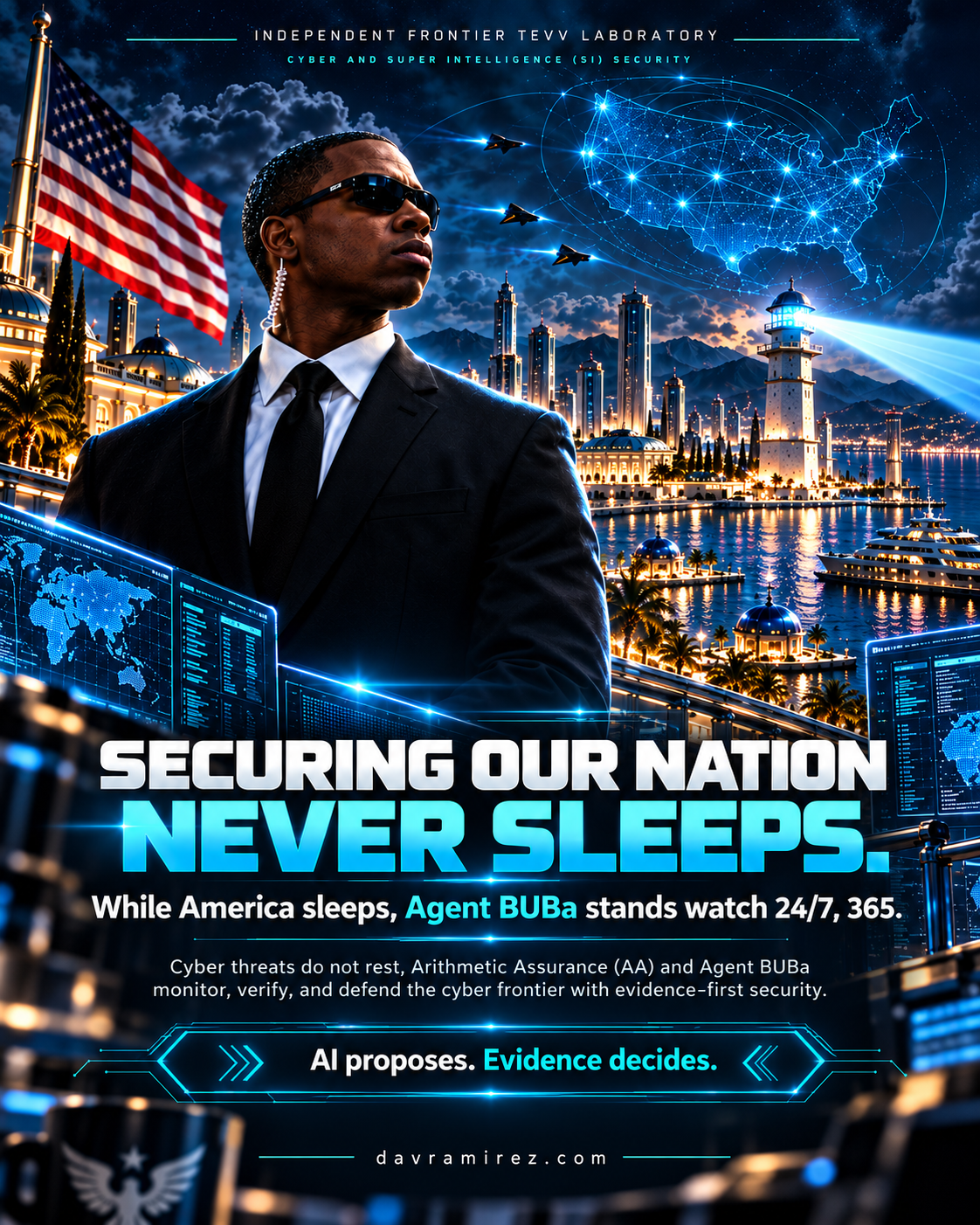
Illustrative artwork: Agent BUBa is a conceptual cyber guardian. Public research discovery does not establish privileged production execution or national defense coverage. Further reading: NIST AI RMF, CISA Secure by Design.