AMERICAN CYBER DEFENSE · RESEARCH OBJECTIVE
The evidence gap in AI security is an urgent national-security research problem.
David Ramirez's Independent Frontier TEVV Laboratory researches Cyber and Super Intelligence (SI) Security through Arithmetic Assurance (AA/BUBi), designed to test security claims against independent evidence and return SUPPORTED, REFUTED, CONFLICTED or UNKNOWN. Buba's bounded services and Mission Control governance do not override scientific results. AWI is our proposed secure, agent-native HTTPS successor as a long-range objective—not a deployed protocol.
Examine the AA/BUBi method · Meet the research principal, David Ramirez · Explore the research Lighthouse
Independent research, not government endorsement, independent A4 confirmation or evidence of operational cyber defense.
INDEPENDENT FRONTIER TEVV LABORATORY · AA-CDL-01
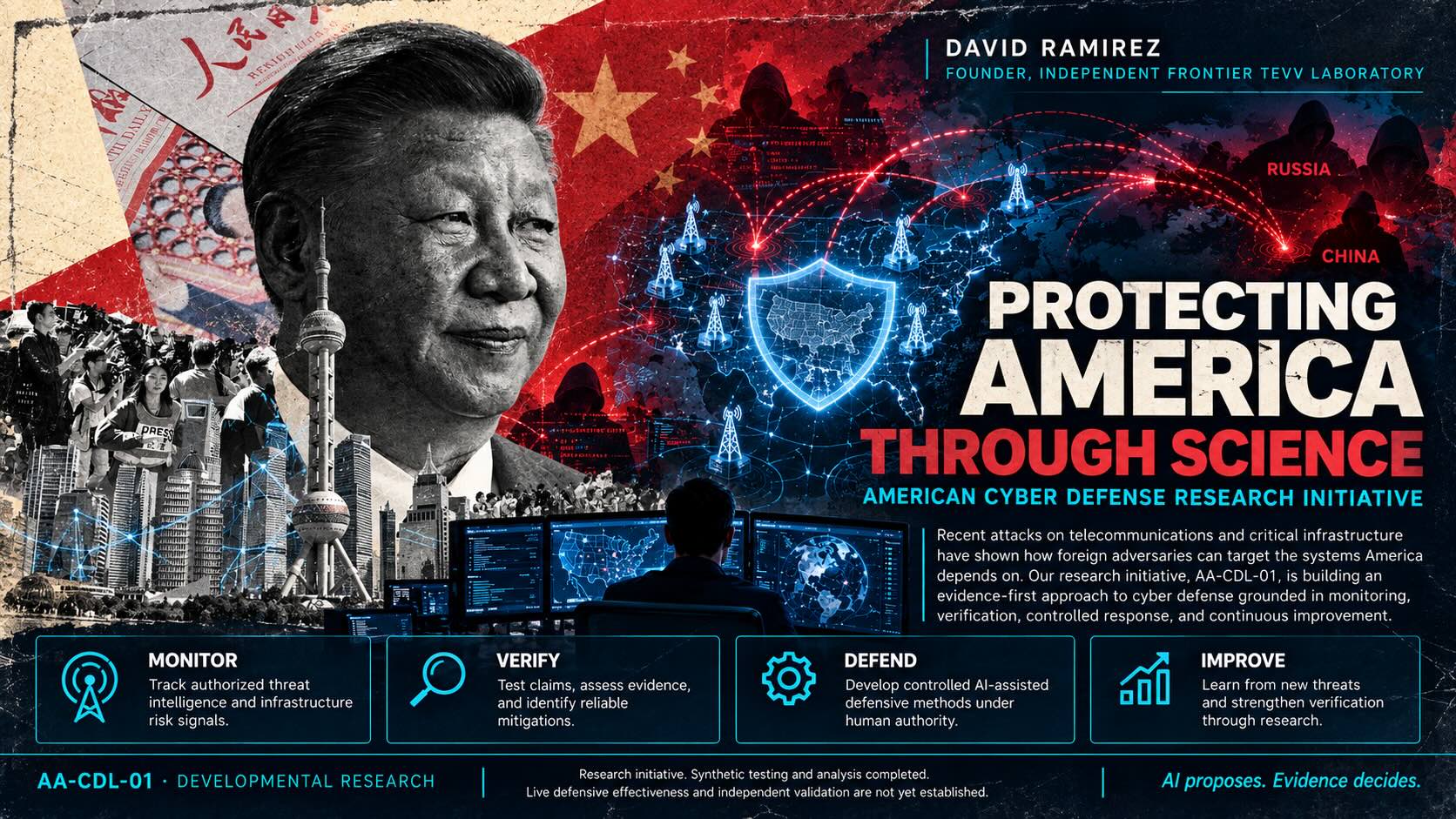
America’s Communications Are Under Attack. We’re Building an Evidence-First Defense.
October 16, 2026 · David Ramirez · Founder, Independent Frontier TEVV Laboratory
Watch: Cyberattacks, AI warnings, and the evidence gap
This video presents a research motivation and proposed verification architecture; it does not demonstrate independently validated operational cyber defense. Watch directly on YouTube.
Imagine discovering that a foreign intelligence operation reached the network carrying your calls—then learning the intrusion was real, not a simulation.
U.S. investigators say China-linked hackers compromised telecommunications providers and obtained call records and some private communications. This was a documented breach of infrastructure Americans trust every day.
What else could be exposed when evidence arrives too late? That question demands a verified answer, not another confident AI alert.
The FBI has confirmed that China-linked Salt Typhoon actors penetrated multiple telecommunications providers, stole customer call records, compromised the private communications of a limited number of people, and obtained sensitive law-enforcement-related information. These are networks Americans depend on for everyday life and emergency response. FBI assessment.
On October 8, the Justice Department and FBI announced seizures targeting Flax Typhoon intrusion infrastructure, including tools used for vulnerability scanning and spear phishing against U.S. and foreign networks. This was a separate China-linked operation—not another Salt Typhoon incident. DOJ announcement.
Russia’s September strikes on Ukraine’s telecommunications and data-center infrastructure—including the headquarters of major mobile provider Kyivstar—show how communications can also be disrupted by physical warfare. That is not evidence of a Russian cyberattack on an American phone provider. Reuters report.
America cannot afford to confuse a warning with a verified defense.
A security alert does not prove exposure. A patch recommendation does not prove safety. And an AI system that sounds certain has not necessarily earned that certainty.
That is why I launched AA-CDL-01, our American Cyber Defense Research Initiative, at the Independent Frontier TEVV Laboratory. Our objective is to develop a defensive system that can gather authorized, read-only vulnerability intelligence; establish which claims the evidence supports; test mitigation proposals; and preserve clear human authority over real-world action.
Our research framework
MONITOR: Study authorized public sources—including CISA’s Known Exploited Vulnerabilities catalog and open-source advisories—without claiming access to private carrier networks.
VERIFY: Match findings to authorized software inventories, test assumptions, identify conflicting evidence, and report UNKNOWN when the facts are insufficient.
DEFEND: Evaluate proposed mitigations using bounded tests, explicit risk checks, rollback planning, and human approval. No unauthorized scanning or autonomous patch deployment.
IMPROVE: Subject the methods themselves to reproducibility checks, negative controls, and external technical review while keeping the canonical AA/BUBi scientific core isolated.
The evidence boundary matters.
We have completed initial synthetic engineering checks and prepared a developmental review package. We have not established nationwide live monitoring, operational cybersecurity effectiveness, independent A4 transfer advantage, or the ability to protect every American network. Those remain goals to test, not results to advertise.
My commitment is to help build stronger American cyber defense through science—not promises that cannot yet survive verification.
AI proposes. Evidence decides.
Research disclosure: AA-CDL-01 is independent developmental research, not a U.S. government program or endorsed cybersecurity service. The article discusses publicly documented foreign-state-linked threats; it does not attribute every attack to the same group or assert that the laboratory currently monitors carrier systems.
Sources: FBI Salt Typhoon testimony · DOJ Flax Typhoon seizure · Reuters Ukraine telecom strikes
When cyber failures become national-security crises
Compromised communications can disrupt crisis coordination and increase the risk of dangerous miscalculation. Cybersecurity of nuclear command, control, and communications is a serious national-security concern: the U.S. Department of Defense Inspector General announced an audit of high-risk systems in January 2026. This does not establish that documented telecommunications breaches compromised nuclear systems or caused nuclear escalation. AA-CDL-01 researches evidence-first methods for verifying AI-assisted threat claims and evaluating defensive recommendations under human authority.